Materials
Coral Reef Organisms, the natural model for Coral-Inspired Reef-Safe Sunscreen
Coral-Inspired Reef-Safe Sunscreen: the human application

Inspired by: Coral Reef Organisms

Coral-Inspired Reef-Safe Sunscreen

Soliome

0

Banned UV-filter chemicals in the formulation

No oxybenzone, octinoxate, or similar reef-toxic compounds

310–360nm

UV absorption range of MAAs

Covers both UVA and UVB spectra relevant to sunburn and photoageing

100%

Biodegradability of MAA compounds

Water-soluble and enzymatically degraded; no marine sediment accumulation

The Problem

Conventional chemical sunscreen ingredients such as oxybenzone and octinoxate bleach coral reefs, disrupt marine endocrine systems, and are being banned globally, while mineral alternatives leave white residue and raise nanoparticle safety concerns.

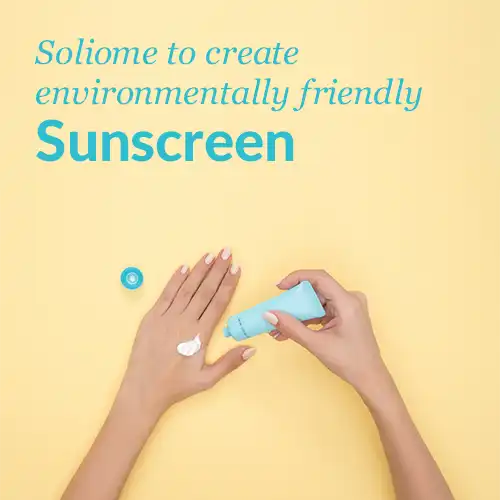
Mycosporine-like amino acids replace oxybenzone in sunscreen

Oxybenzone and octinoxate — the two most common UV-filter chemicals in conventional sunscreen — are now banned for sale in Hawaii, Palau, and several other jurisdictions after research confirmed they bleach coral reefs, disrupt fish endocrine systems, and persist in marine sediment. The reef-safe sunscreen market has surged in response, but most alternatives replace chemical filters with mineral zinc oxide, which leaves a white cast on darker skin tones and presents its own nanoparticle concerns.

Corals and their symbiotic dinoflagellates have been solving UV protection in saltwater environments for hundreds of millions of years. They synthesise mycosporine-like amino acids — small, water-soluble molecules that absorb strongly in the UVA and UVB ranges through a non-photosensitising mechanism. Unlike chemical UV filters, MAAs do not generate reactive oxygen species upon photon absorption; instead, they dissipate UV energy thermally. They are fully biodegradable and have shown no toxicity to marine invertebrates, fish, or human cells at realistic concentrations.

Soliome is producing MAAs through microbial fermentation, scaling up biosynthetic pathways originally characterised in marine algae. Their lead compound, palythine, is being formulated into commercially viable sunscreen products that provide broad-spectrum UV protection without oxybenzone, octinoxate, or mineral whiteners. Because MAAs are water-soluble, they can also be incorporated into cosmetic carriers that conventional mineral filters cannot enter.

Beyond sunscreen, MAA chemistry represents a broader class of bio-inspired UV-protective additives for coatings, textiles, and optics — applications where synthetic UV absorbers currently create environmental persistence or reactive oxygen species problems. The coral reef, ironically, may supply the chemistry needed to protect swimmers who wish to protect it in return.
Biomimicry Breakdown

The Biomimicry Analysis

How Coral Reef Organisms translates into Coral-Inspired Reef-Safe Sunscreen

Term
Applied to Coral-Inspired Reef-Safe Sunscreen
Function
Coral reef organisms synthesise mycosporine-like amino acids that absorb UVA and UVB radiation and dissipate the energy thermally — providing broad-spectrum UV protection without generating reactive oxygen species or persisting in marine environments.
Mechanism
MAAs are produced via microbial fermentation of biosynthetic pathways from marine algae; the resulting water-soluble compounds are formulated into sunscreen products that absorb UV energy through non-photosensitising molecular transitions.
Design Principle
Nature-evolved UV protection already operates in the chemical environment that synthetic sunscreens damage: by using the coral's own photoprotective chemistry, the product is inherently compatible with marine ecosystems rather than hostile to them.
Resulting Design
A reef-safe, broad-spectrum sunscreen without oxybenzone, octinoxate, or whitening mineral particles — biodegradable, water-soluble, and compatible with sensitive marine environments, meeting regulations in Hawaii, Palau, and emerging global bans.

Find your own nature-inspired opportunities

Inspired by Coral-Inspired Reef-Safe Sunscreen? The Biomimicry Opportunity Map scans your company website and suggests challenges worth solving the way nature would.

Get started →

Apply This

Design Application Prompts

There's a natural world to explore

Learn to find strategies like this yourself