This data centre eliminates energy-intensive cooling by locating in a mountain tunnel and using Murray's Law of biological branching to optimise duct networks for thermal distribution.
The Mountain Data Centre represents a radical rethinking of how data infrastructure can be powered and cooled, designed by Exploration Architecture in Norway. Rather than constructing a building in a conventional location and then engineering expensive active cooling systems to manage server heat output, the designers asked a more fundamental question: where in nature do we find environments that naturally maintain optimal thermal conditions? The answer: inside mountains, where bedrock temperature stabilises year-round at approximately 8-12°C, providing free passive cooling impossible to achieve in surface buildings.
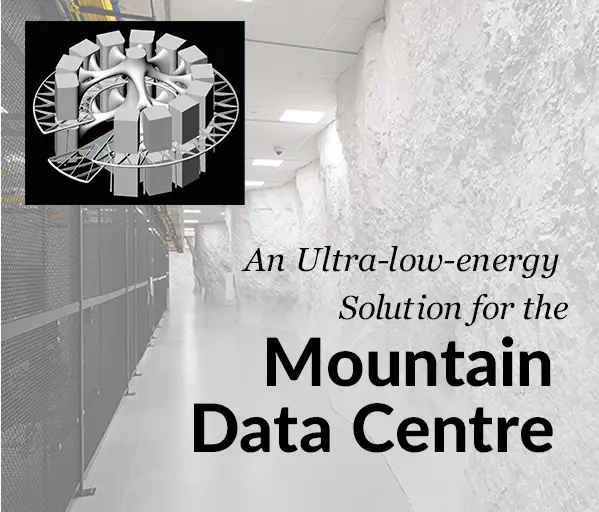
By locating the data centre inside an existing mountain tunnel, the facility eliminates the need for energy-intensive mechanical air conditioning systems that typically consume 30-50% of data centre operational energy. Cold bedrock and mountain air provide continuous passive cooling. However, distributing this cooling efficiently through server racks and equipment required solving a distribution challenge—how to move coolant through branching duct networks with minimal pressure loss and maximum efficiency.
The solution draws from Murray's Law, a fundamental principle of biological hydraulic networks. This law governs how blood vessels, breathing tubes, and water distribution systems in organisms branch optimally to minimise energy loss whilst delivering nutrients/oxygen/water throughout biological systems. The principle states that at each bifurcation, vessel diameters follow a precise mathematical relationship (d₀³ = d₁³ + d₂³) that minimises flow resistance. Applied to the data centre's cooling duct network, Murray's Law optimisation creates branching pathways that distribute cool air with minimal pressure drop, energy waste, and noise.
The facility's circular layout for data blocks further enhances efficiency—a topology inspired by biological clustering patterns. Despite the remote mountain location, high-speed data transmission infrastructure compensates, making remote operation feasible. The Mountain Data Centre demonstrates that sustainable infrastructure design requires rethinking fundamental assumptions about where facilities should be located and how they should operate, not simply adding green technology to conventional buildings.