The Problem
Flue towers and large facades require heavy structural materials to achieve strength and durability. This adds weight, embodied carbon, and construction cost. Traditional engineering approaches assume that strength requires mass.
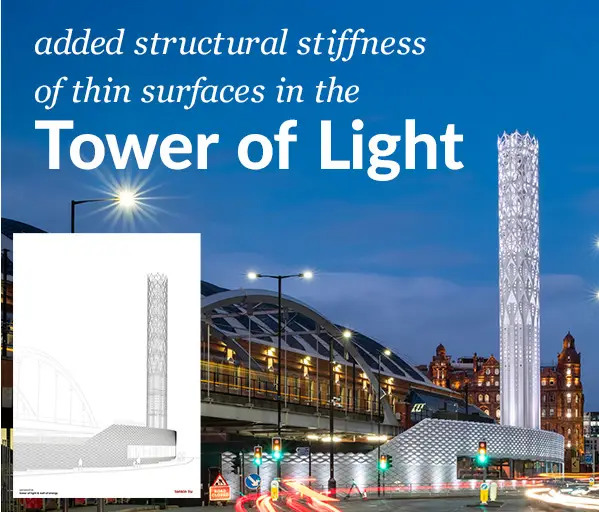
This Manchester flue tower uses mollusc shell-inspired lace structure with thin steel sheets (6-8mm) and perforations to achieve remarkable lightness without sacrificing strength.
The Tower of Light in Manchester represents a breakthrough in biomimetic structural engineering, pioneered by architect Tonkin Liu in collaboration with structural engineering firm Arup. The tower's facade draws direct inspiration from marine mollusc shells—structures that have evolved over millions of years to achieve maximum strength with minimal material investment. The shell-lace structure is characterised by elegant folds, curves, and twists that impart remarkable structural strength to thin planar surfaces, demonstrating that geometry itself can substitute for material thickness.
The facade employs steel sheets just 6-8mm thick—barely thicker than heavy paper—yet achieves the structural capacity of much heavier conventional facades. This is accomplished through the strategic use of perforations (cut-outs) that reduce weight dramatically while maintaining structural integrity. Each perforation is carefully positioned to avoid compromising load paths, much like the porous structure of mollusc shells reduces total material whilst distributing stress efficiently. The overall effect is a structure that uses only a fraction of the material a conventional flue tower would require, dramatically reducing embodied carbon and construction costs.
The Tower of Light achieved widespread recognition through multiple prestigious awards: the Building Beauty Awards (2022), Structural Design Awards (2022), and Net Zero Future Cities Forum Awards (2020). These accolades reflect how the project demonstrates that biomimetic design is not a niche aesthetic choice but a path to genuinely superior engineering outcomes. The tower stands as proof that by studying how molluscs build shells of extraordinary strength from calcium carbonate, architects and engineers can develop lightweight, beautiful structures that reduce environmental impact while improving performance.