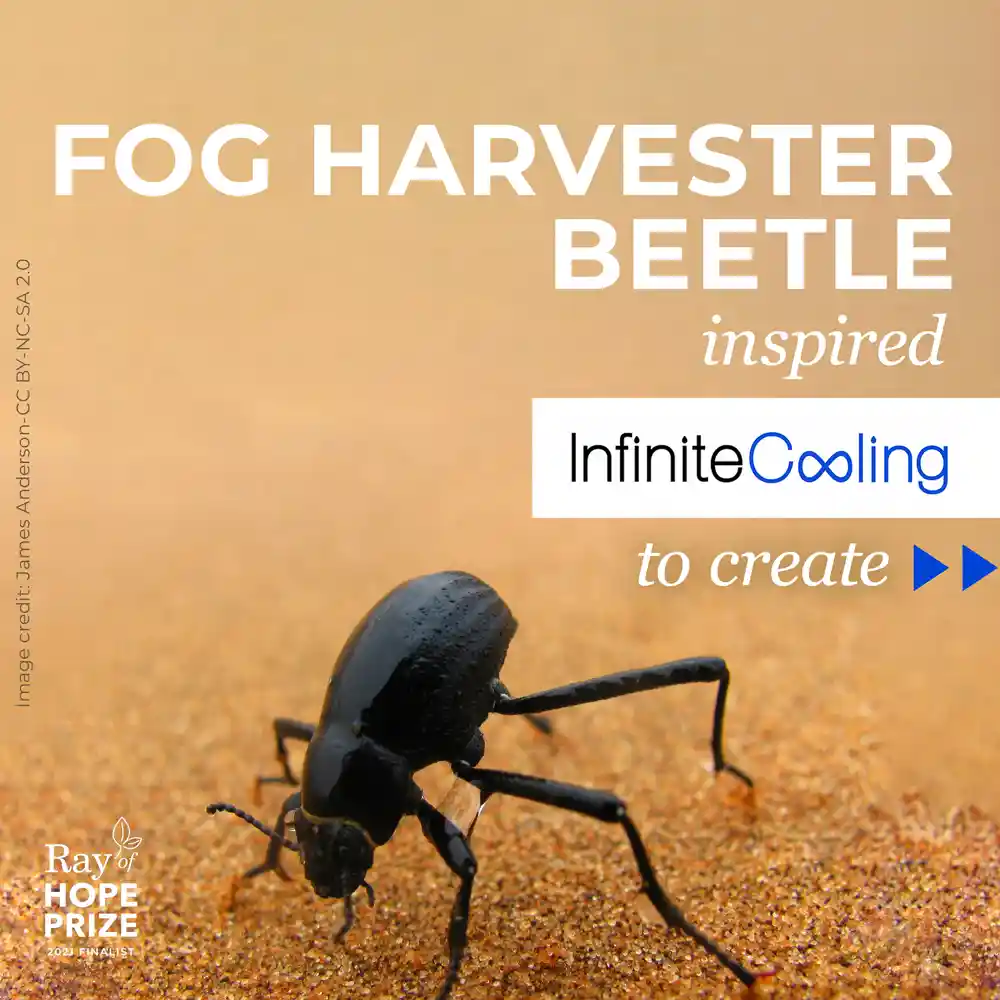
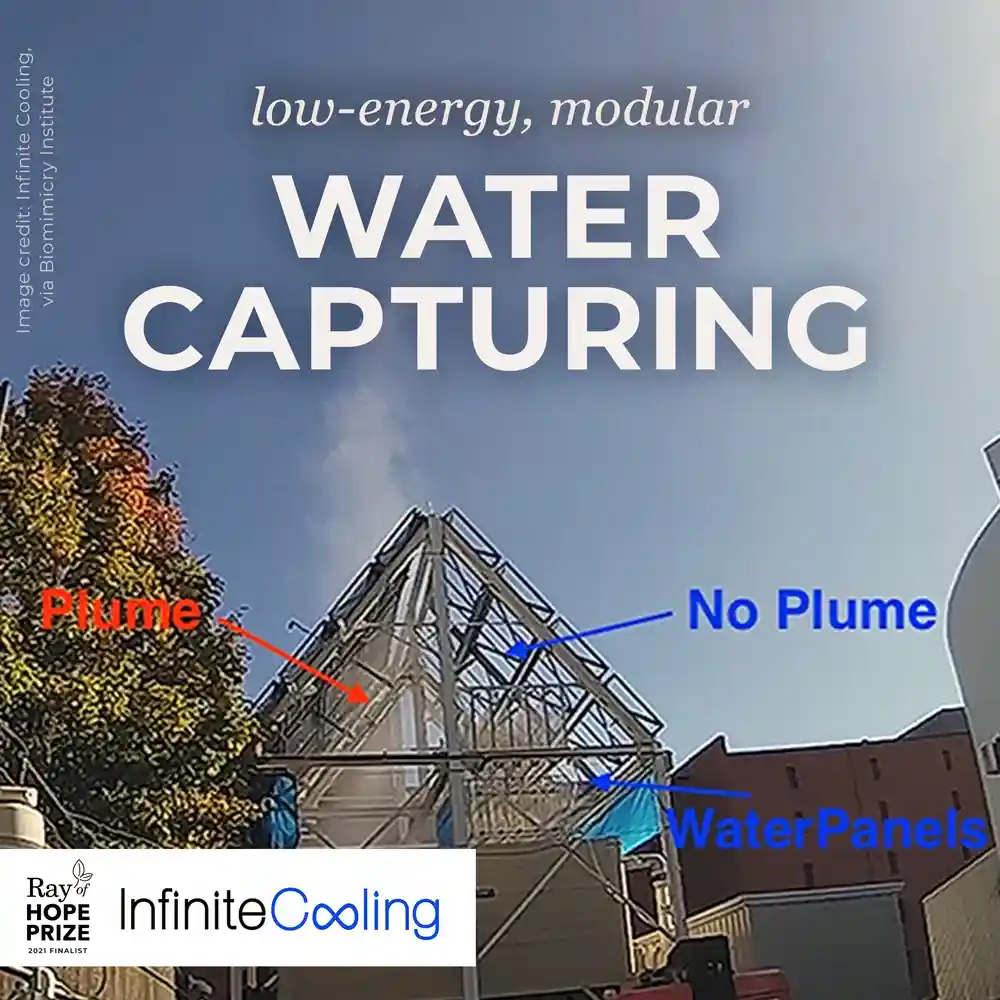
Infinite Cooling developed fog harvesting technology inspired by the fog-harvesting beetle. Microscopic surface patterns collect water from fog without energy input, enabling water collection in arid regions.
Stenocara gracilipes, a beetle from the Namibian desert, survives in one of the world's driest regions by harvesting water directly from fog. The beetle's elytra (wing covers) have alternating hydrophobic and hydrophilic patches at microscopic scale. When fog blows over the beetle, water droplets condense on hydrophilic patches, grow, and eventually roll down to hydrophobic patches where they slide together and flow toward the beetle's mouth. The beetle collects several milliliters of water per night—enough to survive in an environment with virtually no rainfall. Infinite Cooling reverse-engineered this mechanism into synthetic surfaces and fog collection systems. The technology creates micro-patterned materials (metals, plastics, or fibers) with alternating water-attracting and water-repelling patches. When fog or mist passes over these surfaces, water condenses on hydrophilic patches, collects, and flows down hydrophobic patches via gravity. The collected water can be directed to collection systems. Advantages are enormous: completely passive (no energy input), works in any climate with fog (not just deserts), scales from personal to community water systems, and requires zero chemicals or filtration (fog is relatively clean). Challenges include variable fog conditions and scaling for large water volumes. The technology is being deployed in arid regions globally, with the potential to provide water security in water-scarce areas. This represents one of biomimicry's most elegant solutions: understanding how an organism solved a problem (water scarcity) and replicating the solution synthetically.