Every autumn, fashion warehouses discard tonnes of unsold garments whose dyes are already fixed and unfixable. The textile industry accounts for roughly 20 percent of global industrial water pollution, much of it from synthetic dyes that cannot be recaptured once applied. A quieter problem runs alongside it: conventional pigment-based inks and coatings fade, chip, and leach chemicals throughout their service lives, requiring periodic recoating.
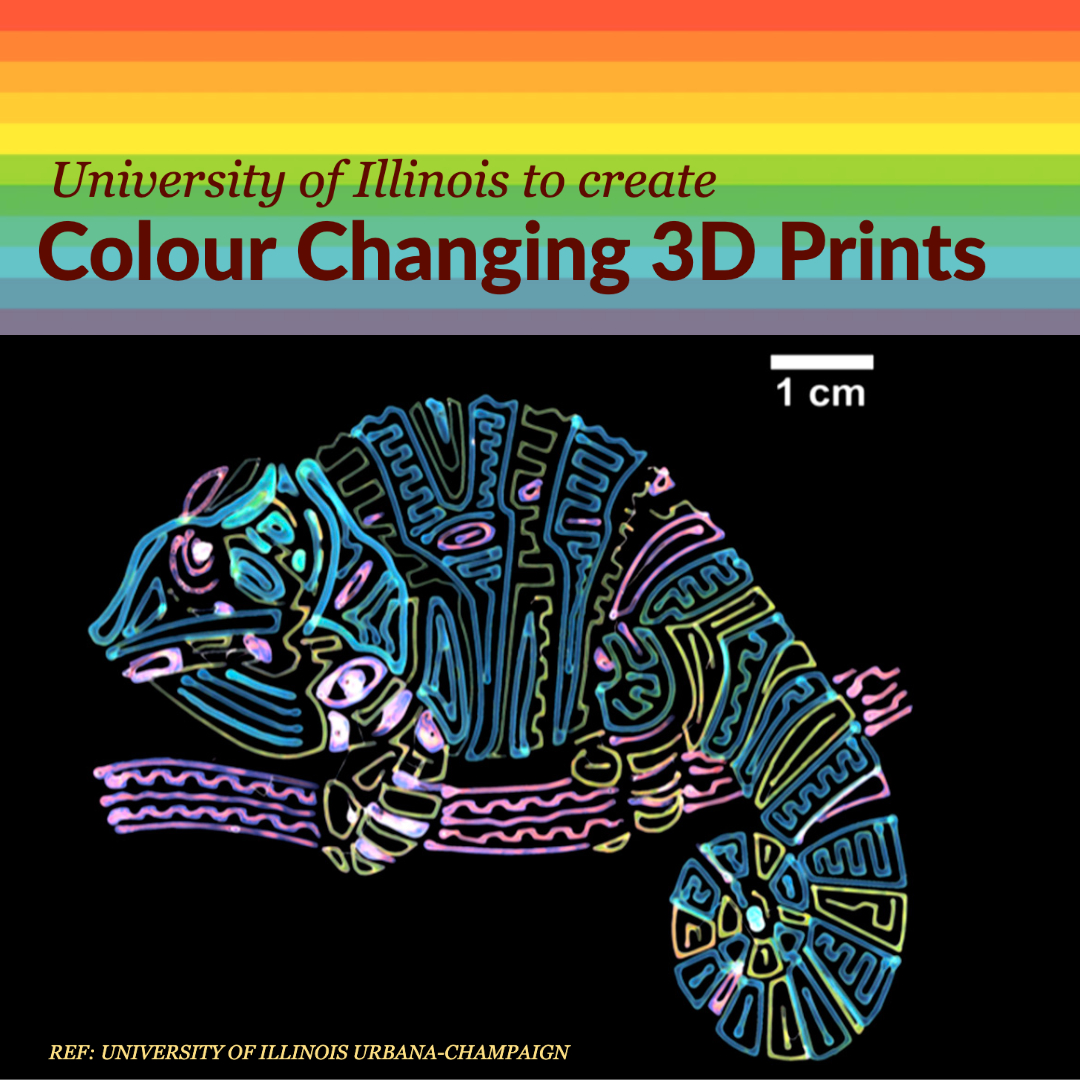
Researchers at the University of Illinois took inspiration from the panther chameleon, which produces its spectacular colour shifts not by synthesising new pigment molecules but by mechanically tuning the spacing of guanine nanocrystal arrays in its skin. When the lattice expands, it reflects longer red wavelengths; when it contracts under excitement, it reflects shorter blue ones. Colour is a structural phenomenon, not a chemical one — and no pigment is ever used or depleted.
The team embedded polymer microspheres into 3D-printable resin at precisely controlled spacings, creating periodic nanostructures that interfere with and reflect specific visible wavelengths. By varying microsphere diameter and inter-particle spacing during printing, they could programme any colour into any region of an object at the point of manufacture — without dye, without ink, and without post-processing. The resulting colours are inherently fade-resistant because they depend on geometry rather than chromophore stability.
Beyond aesthetics, structural colour offers functional benefits: the same interference principle can be tuned to manage solar gain in building facades, modulate emissivity in satellite components, or provide anti-counterfeiting features that cannot be scanned or copied. As additive manufacturing scales, nanocrystal lattice printing could eliminate entire dye-supply chains while producing more vivid, durable, and spectrally precise colour than any pigment system can achieve.