Computing
Human / Mammalian Bone, the natural model for Bone-Inspired Generative Design
Bone-Inspired Generative Design: the human application

Inspired by: Human / Mammalian Bone

Bone-Inspired Generative Design

Autodesk

30–75%

Mass reduction in generative-designed aerospace and automotive components

Bone-inspired material redistribution removes unused structure without sacrificing performance

~1M

Geometric variants evaluated per design run

Algorithm explores solution spaces no human designer could survey manually

3x

Reduction in design-to-validation cycle time for Airbus brackets

Dreamcatcher-designed A320 partition bracket used in production aircraft

The Problem

Conventional structural components carry significant excess material because human designers apply uniform safety margins, lacking tools to explore the millions of geometric variants that would reveal the truly optimal structure for a given load case.

Trabecular bone growth algorithms optimise structural components

Structural components in aerospace, automotive, and industrial machinery are typically designed by engineers who start from intuition or precedent, then validate and iterate. The result is shapes that work but carry significant excess material — safety margins applied uniformly rather than precisely. A conventional aluminium bracket might use three times the material that a topologically optimal version would require for the same structural performance, simply because no human designer has time to explore millions of geometric variants.

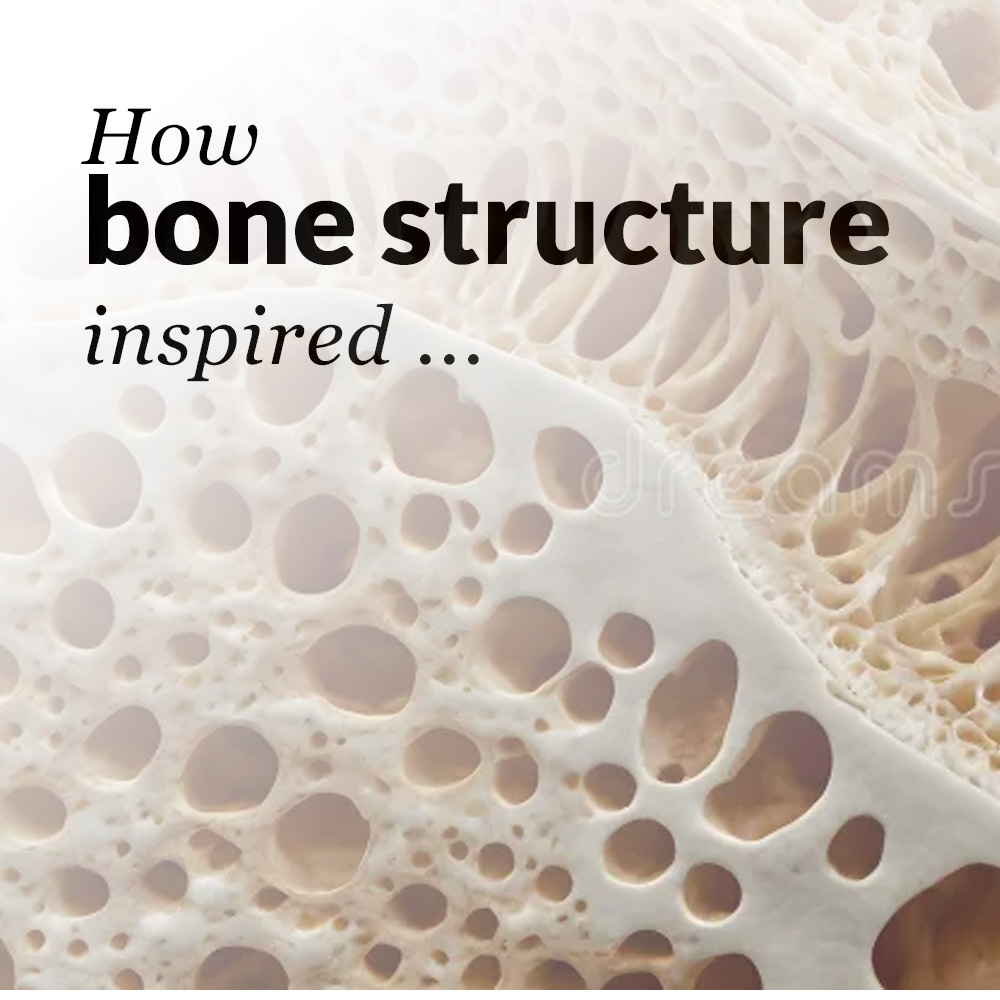
Bone does not have this problem. Trabecular bone — the internal lattice structure of long bones — continuously removes material from low-stress regions and deposits it along load paths through osteoclast and osteoblast activity. Over millions of loading cycles, bone converges on a structure that carries its specific loads with minimal mass. The resulting geometry is branching, irregular, and counterintuitive — but mechanically near-optimal for exactly that loading scenario.

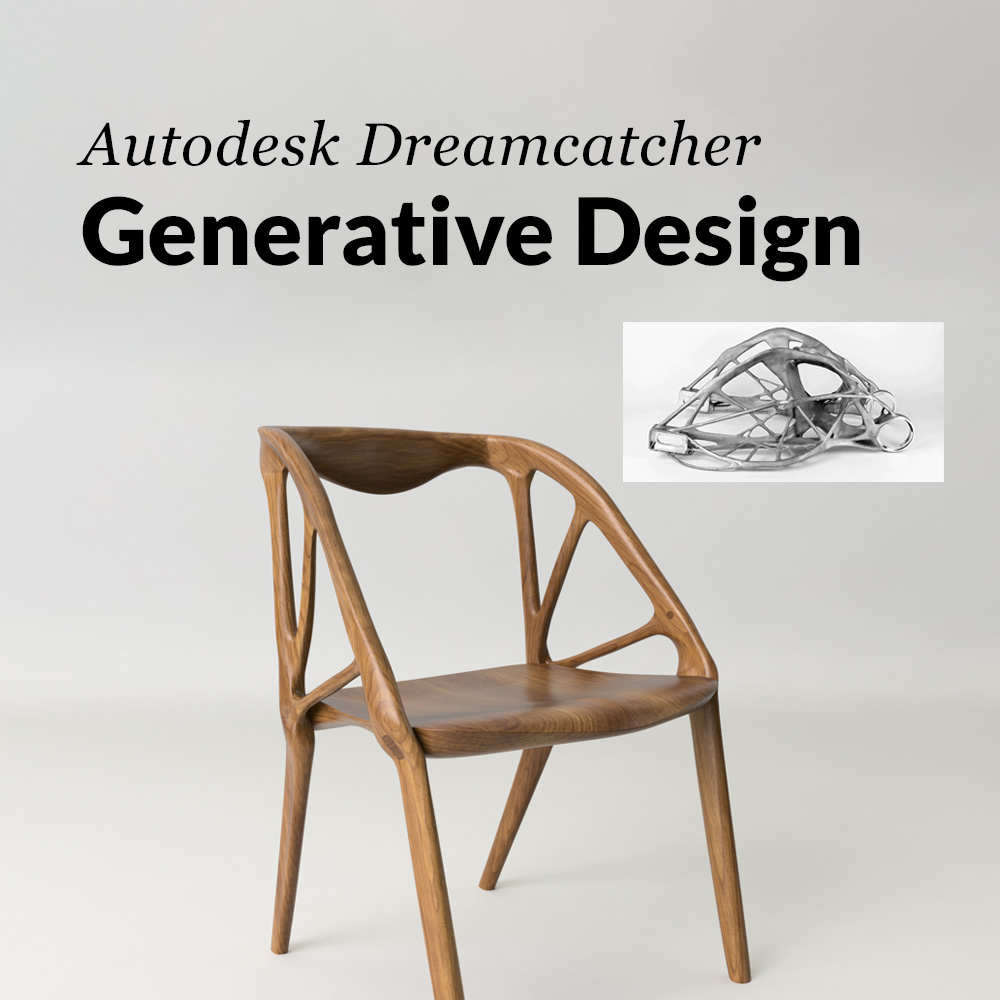
Autodesk's Dreamcatcher, now embedded in Fusion 360 as generative design, applies analogous optimisation to engineering components. The designer specifies boundary conditions, loads, constraints, and manufacturing method; the algorithm iteratively adds and removes material from a voxel mesh, guided by stress tensor fields, until the mass is minimised for the target safety factor. The output geometries are distinctly bone-like: branching struts, hollow cores, and load-following curves that no conventional design process would produce.

In production use, generative design has reduced component mass by 30–75 percent in aerospace brackets, automotive suspension parts, and industrial fixtures. Crucially, the weight savings are specific and structural, not cosmetic: every gram removed represents material that was genuinely unused under the design load case. Combined with additive manufacturing, which can fabricate the complex organic geometries the algorithm proposes, bone-inspired optimisation is beginning to reshape what structural components look like.
Biomimicry Breakdown

The Biomimicry Analysis

How Human / Mammalian Bone translates into Bone-Inspired Generative Design

Term
Applied to Bone-Inspired Generative Design
Function
Trabecular bone continuously redistributes mass along active stress paths and removes it from under-stressed regions through osteoclast-osteoblast feedback — converging on a structure with optimal stiffness-to-weight ratio for its specific loading environment.
Mechanism
Generative design algorithms iteratively add and remove material from a voxel mesh guided by stress tensor fields, mimicking bone remodelling; the designer specifies loads, constraints, and manufacturing method, and the algorithm returns a near-optimal geometry.
Design Principle
Design by stress-guided material redistribution replaces design by intuition: just as bone removes material from unstressed regions and concentrates it along load paths, the algorithm minimises mass while maintaining structural performance — producing geometries that follow forces rather than human convention.
Resulting Design
Production aerospace, automotive, and industrial components with 30–75 percent mass reduction versus conventionally designed equivalents, with every gram removed verified against structural requirements rather than estimated by safety-factor excess.

Find your own nature-inspired opportunities

Inspired by Bone-Inspired Generative Design? The Biomimicry Opportunity Map scans your company website and suggests challenges worth solving the way nature would.

Get started →

Apply This

Design Application Prompts

There's a natural world to explore

Learn to find strategies like this yourself