Computing
Western Honeybee, the natural model for Honeybee Foraging Algorithm
Honeybee Foraging Algorithm: the human application

Inspired by: Western Honeybee

Honeybee Foraging Algorithm

Erciyes University (Prof. Derviş Karaboğa)

3

Agent types needed to model entire colony behaviour

Scout, employed, and onlooker bees encode exploration, exploitation, and selection

15%

Average improvement over particle swarm optimisation on benchmark functions

ABC outperforms PSO and GA on multimodal test suites

0

Central coordinators required

Emergent optimisation arises from local dance-inspired interactions alone

The Problem

Distributed computing systems must allocate tasks across hundreds of servers in real time without central coordinators, yet conventional load-balancing algorithms stagnate on unpredictable or shifting workloads.

Distributed optimisation modelled on bee scout-recruit cycles

Distributed computing clusters and data centres face a persistent allocation problem: how do you assign thousands of incoming tasks across hundreds of servers in real time, without a single coordinator that becomes a bottleneck or a point of failure? Traditional load balancers use deterministic rules that optimise for average throughput but struggle when workloads are unpredictable or heterogeneous. Genetic algorithms and simulated annealing can find good solutions but are computationally expensive and slow to adapt.

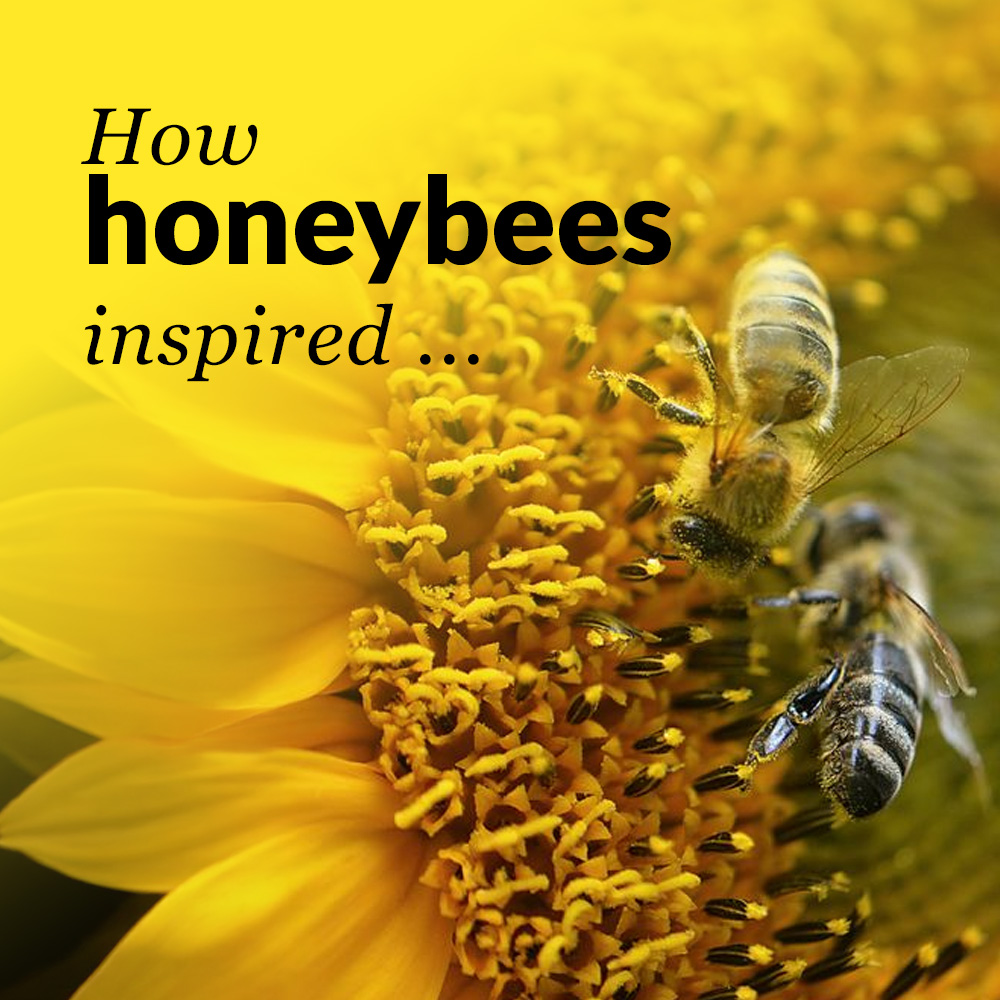
Honeybee colonies solve an analogous problem every day. Thousands of foragers must collectively discover the highest-yield flower patches across square kilometres of landscape without central planning. Scout bees explore randomly; those who find good sources return and perform waggle dances whose duration encodes the quality and direction of the patch. The better the source, the longer the dance and the more recruits it attracts. Sources that degrade are abandoned; new scouts continuously probe unexplored areas. The colony maintains a dynamic balance between exploitation of known good sources and exploration of unknowns.

Professor Derviş Karaboğa at Erciyes University formalised this behaviour as the Artificial Bee Colony (ABC) algorithm in 2005. Three agent types model the colony: employed bees (exploit known solutions), onlooker bees (probabilistically select solutions to exploit based on quality), and scout bees (abandon stagnant solutions and explore randomly). The algorithm outperforms particle swarm optimisation and genetic algorithms on several benchmark multimodal functions, and has been applied to job-shop scheduling, neural network training, and cloud task allocation.

What makes ABC particularly valuable is its graceful degradation: because no single agent holds global state, the algorithm continues to find good solutions even when agents fail or the problem landscape shifts. This mirrors the colony's resilience — a hive with half its foragers still finds food. For dynamic, fault-tolerant optimisation in systems that cannot afford to pause, the waggle dance offers a surprisingly robust template.
Biomimicry Breakdown

The Biomimicry Analysis

How Western Honeybee translates into Honeybee Foraging Algorithm

Term
Applied to Honeybee Foraging Algorithm
Function
Honeybee colonies discover and collectively exploit the richest food sources across large landscapes through a decentralised scout-recruit-abandon cycle encoded in the waggle dance — no central planner, no global map, yet near-optimal allocation emerges.
Mechanism
Three agent classes mirror the colony: employed bees exploit known candidate solutions, onlooker bees select solutions probabilistically by quality (mimicking dance observation), and scout bees abandon stagnant solutions and reinitialise random exploration.
Design Principle
Positive feedback (recruiting more agents to better solutions) and negative feedback (abandoning poor solutions via scouts) balance exploration and exploitation in a self-regulating loop that adapts continuously to shifting problem landscapes.
Resulting Design
The ABC algorithm finds near-optimal solutions to complex multimodal problems including cloud task scheduling, neural network training, and engineering design — with fault tolerance exceeding deterministic methods because no single node holds global state.

Find your own nature-inspired opportunities

Inspired by Honeybee Foraging Algorithm? The Biomimicry Opportunity Map scans your company website and suggests challenges worth solving the way nature would.

Get started →

Apply This

Design Application Prompts

There's a natural world to explore

Learn to find strategies like this yourself