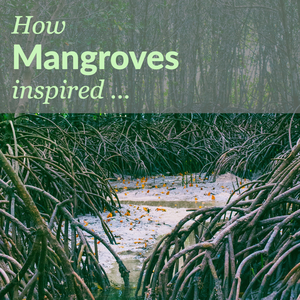
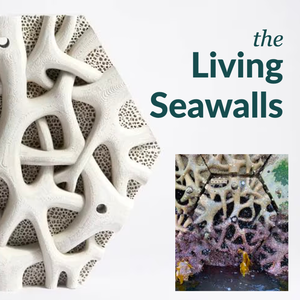
Mangrove root systems stabilise trees in shifting tidal sediments by spreading loads across dozens of branching roots rather than concentrating force in a single trunk. Engineers are applying this branching foundation principle to offshore wind turbines to dramatically reduce steel use and installation cost.
Conventional offshore wind turbines use a monopile foundation — a single large-diameter steel cylinder driven into the seabed. These monopiles require enormous quantities of steel (some reaching 8m in diameter and 80m in length) and specialised installation vessels. As turbines move into deeper water, monopile costs increase exponentially.
The red mangrove tree solves a similar structural challenge in a different way. Growing in soft, shifting tidal sediments, mangroves cannot rely on a deep taproot. Instead, they develop a spreading network of arching prop roots that collectively distribute the tree's load across a wide area of soft substrate. The root architecture also helps the tree resist tidal surge forces.
Engineering firm Arup and researchers at MIT have developed "spider leg" foundations and branching lattice foundations for offshore wind, directly inspired by mangrove root geometry. The branching foundation distributes loads into the seabed across a wider footprint, reducing maximum stress on any single element. Compared to a monopile, a mangrove-inspired foundation uses 30–40% less steel, can be pre-fabricated in modular sections, and can be installed by smaller vessels — significantly reducing the cost of deep-water wind installations.