Architecture
Human femur bone trabeculae, the natural model for Eiffel Tower: Femur-Inspired Hierarchical Structure
Eiffel Tower: Femur-Inspired Hierarchical Structure: the human application

Inspired by: Human femur bone trabeculae

Eiffel Tower: Femur-Inspired Hierarchical Structure

Gustave Eiffel

75%

Material efficiency vs. solid iron

reduction in total material

Withstands 4mph

Wind load resistance

lateral sway at top

3

Structural hierarchy levels

nested truss system

The Problem

Tall structures require massive material investment to achieve sufficient strength against wind and gravitational loads. Traditional solid or uniformly-distributed frameworks are inefficient, using excess material in areas of low stress.

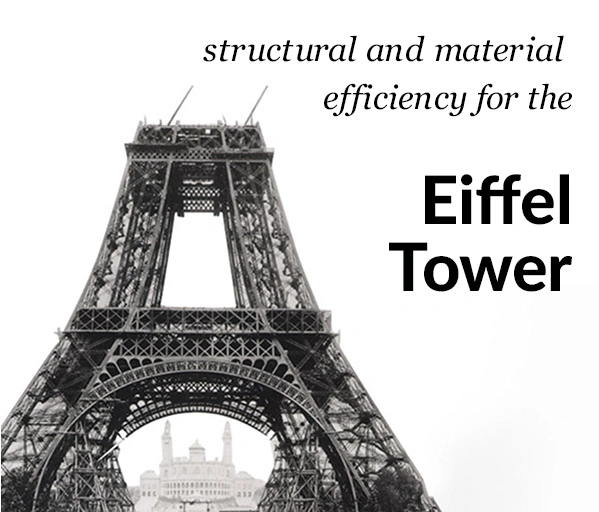
The Eiffel Tower's curved structure and hierarchical truss system mimic the efficient load-bearing design of human femur bone, with supporting elements aligned along lines of force like trabeculae.

The Eiffel Tower stands as a testament to biomimetic engineering principles applied to architectural structure. Gustave Eiffel's masterpiece mimics the internal architecture of the human femur, the longest bone in the body, which must support significant mechanical loads while remaining lightweight. The tower's distinctive curvature mirrors the curves in the femur's head, engineered to withstand bending and shearing forces from wind pressure—much like the femur endures the stresses of human movement and gravity.

At the heart of the tower's brilliance lies its hierarchical structure. Supporting studs and diagonal braces are strategically positioned along principal lines of force, replicating the arrangement of trabeculae—the trabecular bone's internal lattice that optimises strength-to-weight ratio. Rather than using solid sections throughout, Eiffel employed a 3-level nesting truss system that distributes loads through the structure in the same way nature distributes stresses through bone. This creates an architecture of remarkable stiffness with minimal material, achieving fracture control and load distribution that solid structural approaches cannot match.

The efficiency gain is extraordinary: the tower is highly efficient compared to solid iron sections of equivalent strength, using far less material whilst maintaining structural integrity under wind loads and gravitational stress. This biomimetic approach to hierarchical material distribution has become a foundational principle in structural engineering, influencing everything from bridge design to modern skyscraper construction. The Eiffel Tower demonstrates that by observing nature's engineering solutions, humans can create structures that are simultaneously stronger, lighter, and more elegant than conventional alternatives.
Biomimicry Breakdown

The Biomimicry Analysis

How Human femur bone trabeculae translates into Eiffel Tower: Femur-Inspired Hierarchical Structure

Term
Applied to Eiffel Tower: Femur-Inspired Hierarchical Structure
Function
The tower must support its own massive weight and resist wind-induced bending stresses while minimizing material and cost.
Mechanism
Femur bone uses trabecular lattice inside cortical bone shell to reduce weight while maintaining strength. Internal struts align along principal stress lines from repeated loading patterns.
Design Principle
Use hierarchical nesting and stress-aligned reinforcement rather than uniform material distribution. Concentrate material where stresses are highest.
Resulting Design
The Eiffel Tower uses only a fraction of the iron needed for a solid structure of equivalent strength, achieving 18,000 metal parts in precise hierarchical arrangement that rivals nature's efficiency.

Find your own nature-inspired opportunities

Inspired by Eiffel Tower: Femur-Inspired Hierarchical Structure? The Biomimicry Opportunity Map scans your company website and suggests challenges worth solving the way nature would.

Get started →

Apply This

Design Application Prompts

There's a natural world to explore

Learn to find strategies like this yourself