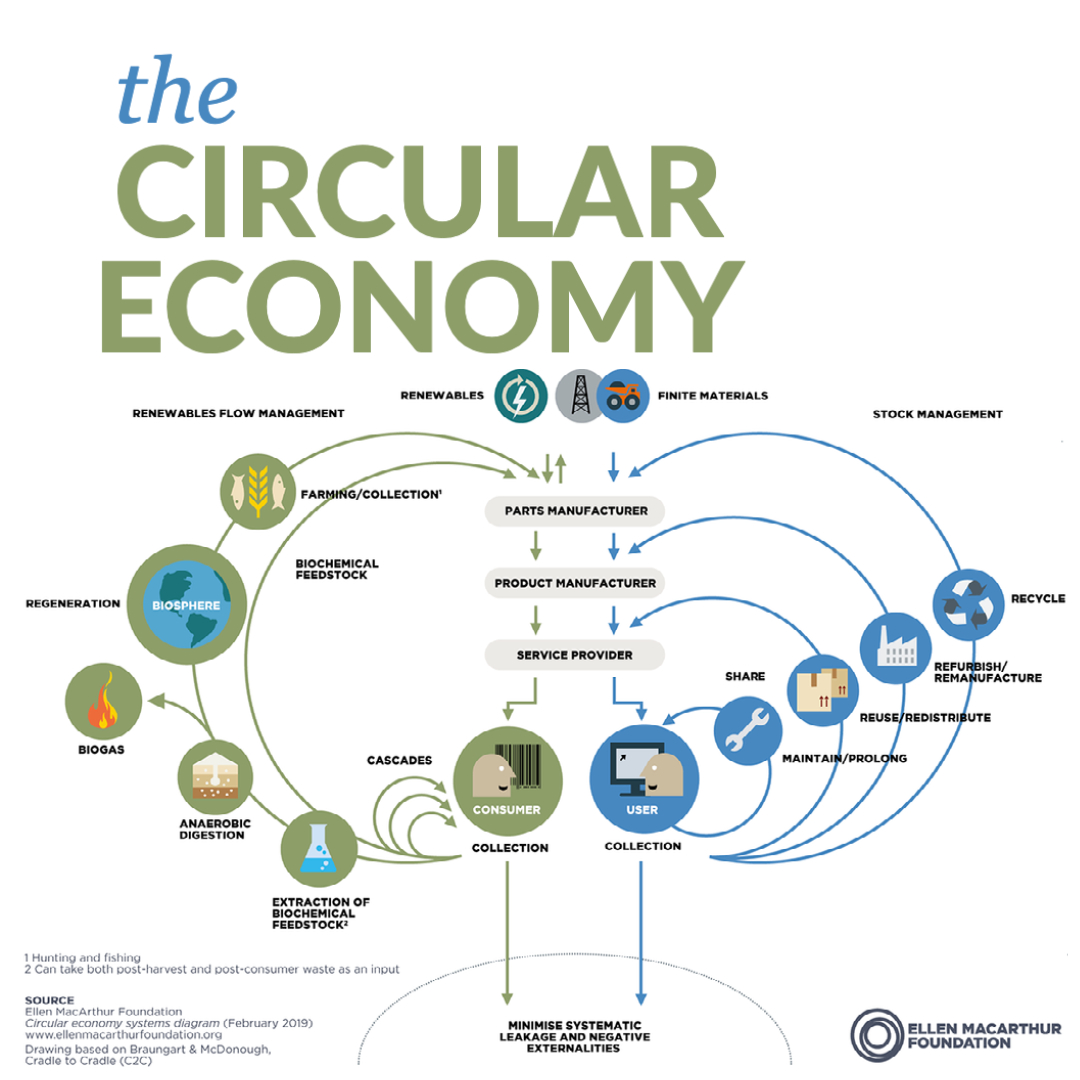
The Ellen MacArthur Foundation develops circular economy frameworks based on ecosystem principles. Circular economies eliminate waste by designing products and systems to cycle continuously through biological or technical loops.
Natural ecosystems operate in closed loops—nutrients, energy, and materials cycle continuously with zero waste. In nature, there is no waste; every organism's byproduct becomes another organism's input. The linear 'take-make-waste' model of industrial production is ecologically unsustainable. The Ellen MacArthur Foundation, founded by sustainable entrepreneur Ellen MacArthur, developed the Circular Economy framework—a systems-level blueprint for eliminating waste and maximizing resource productivity. The framework divides materials into two categories: biologicals (designed to biodegrade and return to soil) and technicals (designed for infinite reuse without degradation). Circular systems are designed backward from end-of-life: a product's final stage is planned before production begins. Applications include product design (using materials that can be recycled infinitely), business models (leasing instead of selling, enabling product recovery), supply chain design (sourcing local, renewable materials), and infrastructure (composting, remanufacturing, reuse systems). The framework has been adopted by major corporations, governments, and city planners. Concrete applications include circular fashion systems (designing textiles for recycling), circular electronics (designing phones and computers for complete material recovery), and circular food systems (eliminating agricultural waste). The Ellen MacArthur Foundation provides education, research, and frameworks to guide this massive systems transition. This represents ecosystem-level biomimicry: designing entire production systems on the principle of natural circular flows.