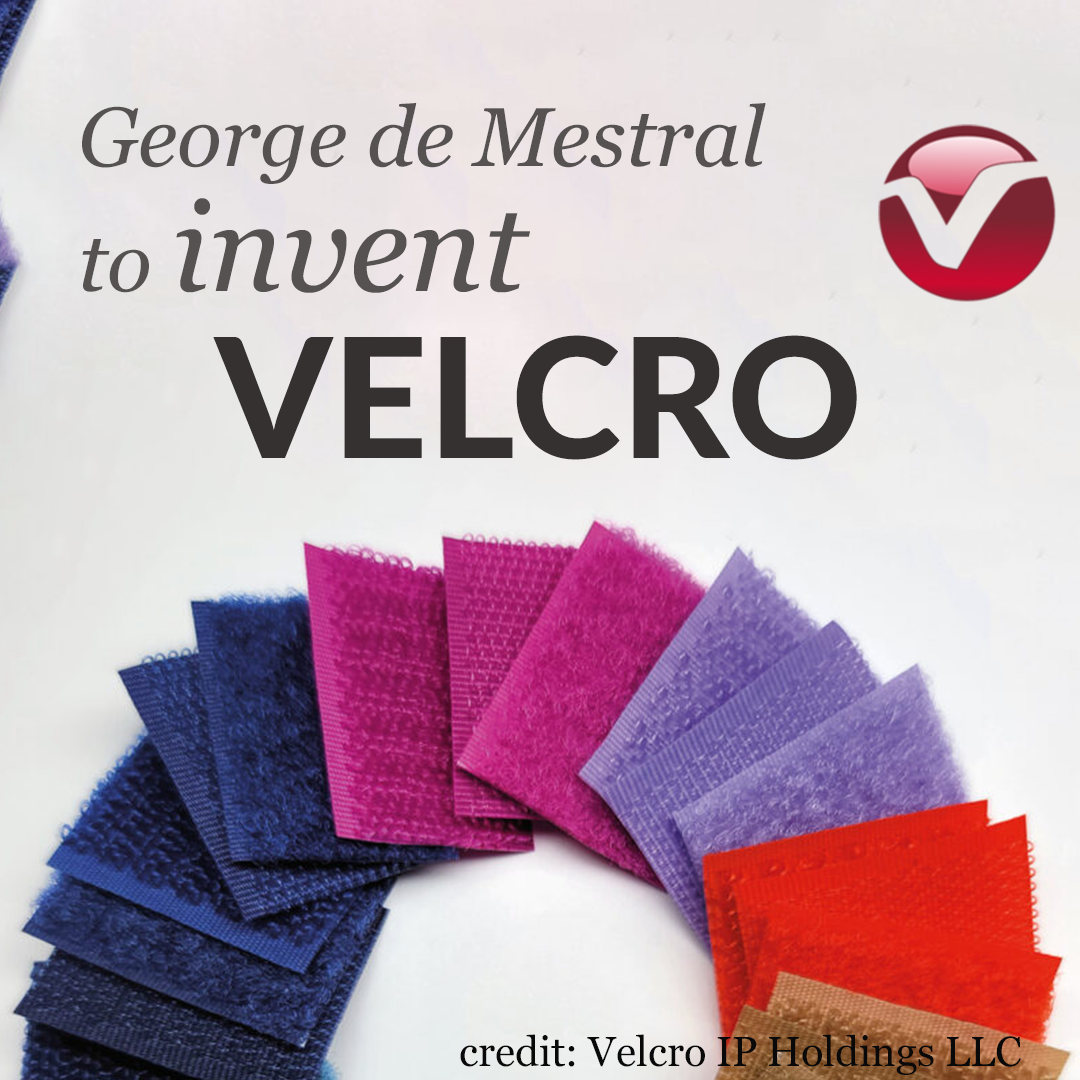
The invention of Velcro — one of the most commercially successful products in history — came directly from Swiss engineer George de Mestral observing how burdock burrs clung to his dog's fur through thousands of tiny hooks that caught on microscopic loops in the fur.
In 1941, Swiss engineer George de Mestral returned from a walk in the Alps and found burdock burrs attached to his coat and his dog's fur. Under a microscope, he saw that the burrs were covered in tiny hooks that caught on the microscopic loops of fibre in cloth and animal fur. The connection was mechanical, not chemical, and it was strong yet easily reversible.
De Mestral spent eight years perfecting a synthetic version using nylon, eventually receiving a patent in 1955. Velcro (from the French velours croché, "hooked velvet") went on to become one of the most ubiquitous fastening technologies in the world.
Initially NASA adopted Velcro extensively for the Apollo program — astronaut suits, equipment fastening, and even interior cabin attachment points. Today it appears in every industry from aerospace to medical (surgical mesh, wound closure strips) to consumer products.
The burdock hook system works because it exploits the same principle of hierarchical structure that appears throughout nature: macro-scale loops and hooks, each terminated at a scale that allows reversible mechanical interlocking. Modern derivatives include ultra-strong "micro-Velcro" for medical implant surfaces and dry adhesive tiles for satellite assembly.