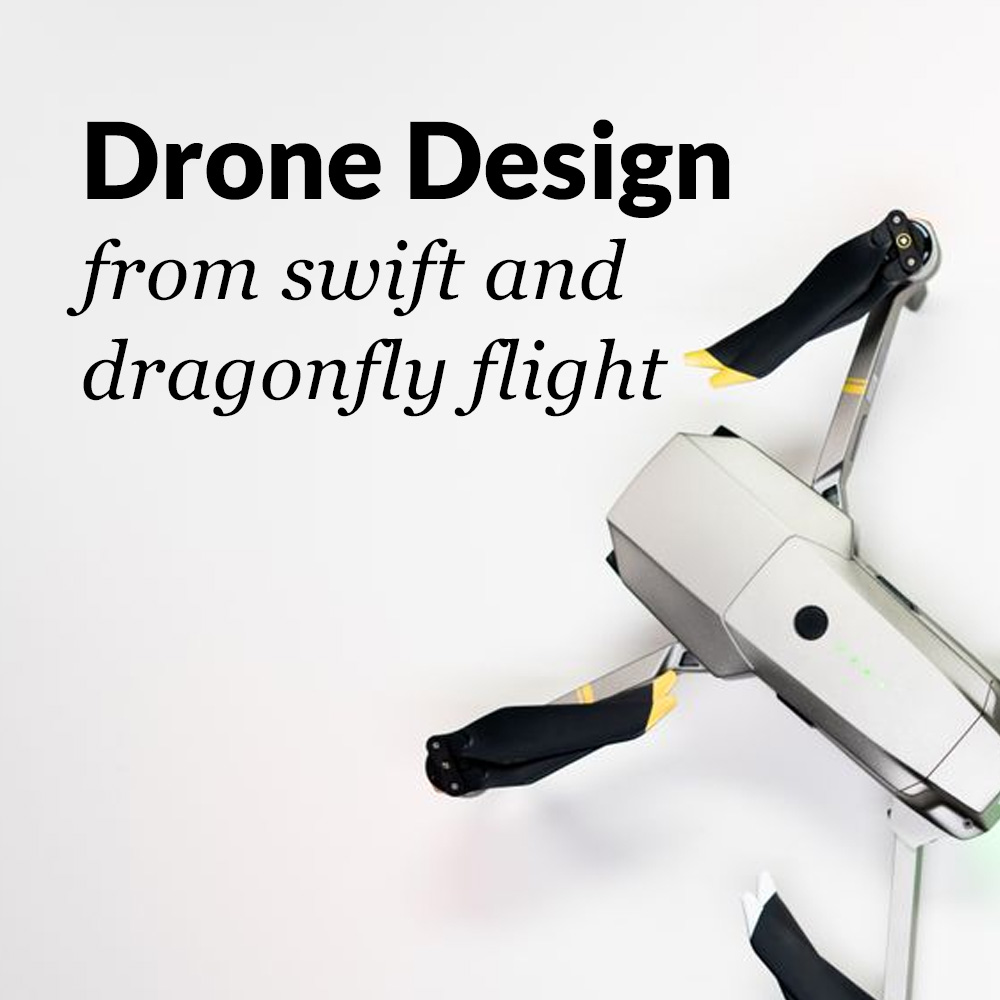
University of South Australia researchers developed drone designs based on swift and dragonfly flight mechanics. These aerial vehicles achieve superior agility, efficiency, and hovering capability by mimicking natural flight patterns.
Swifts are among the most agile flying birds, capable of high-speed maneuvering and rapid acceleration. Dragonflies are perhaps the most maneuverable insects, capable of hovering, rapid direction changes, and independent wing control. Researchers at the University of South Australia studied both organisms to understand how they achieve such remarkable aerial performance. Swifts use cambered (curved) wing profiles, rapid wing beats, and sophisticated control of wing twist to generate lift and control. Dragonflies employ four independent wings, allowing asymmetrical control and complex maneuvers impossible for most flying creatures. The research translated these principles into drone designs with several innovations: cambered wing profiles that generate more lift at lower speeds, rapid flapping mechanisms inspired by natural wing beat frequencies, flexible wing structures that deform adaptively during flight, and independent control algorithms for multi-rotor systems. The resulting drones demonstrate superior hovering efficiency (extended flight time), faster acceleration and deceleration, improved stability in turbulent conditions, and ability to navigate tight spaces. Applications include aerial inspection, search and rescue, environmental monitoring, and military surveillance. The biomimetic designs achieve these capabilities with less power consumption than conventional rigid-wing drones, extending operational range and flight duration. This research represents the intersection of biomechanics, materials science, and control systems—all necessary to translate nature's engineering into functional technology.