Robotics
Octopus (Octopodidae, Muscular Hydrostats), the natural model for Octopus Soft Robots
Octopus Soft Robots: the human application

Inspired by: Octopus (Octopodidae, Muscular Hydrostats)

Octopus Soft Robots

Harvard University, UC Santa Barbara

∞

degrees of freedom

continuous bending vs. discrete joint robots

500

force distribution

pascals sustained pressure across entire arm

95

grip gentleness

percentage object safety for fragile items

The Problem

Rigid-joint robots cannot navigate confined spaces, handle delicate objects safely, or adapt to unpredictable environments. Their discrete degrees of freedom fundamentally limit motor capability.

Muscular hydrostats with infinite degrees of freedom.

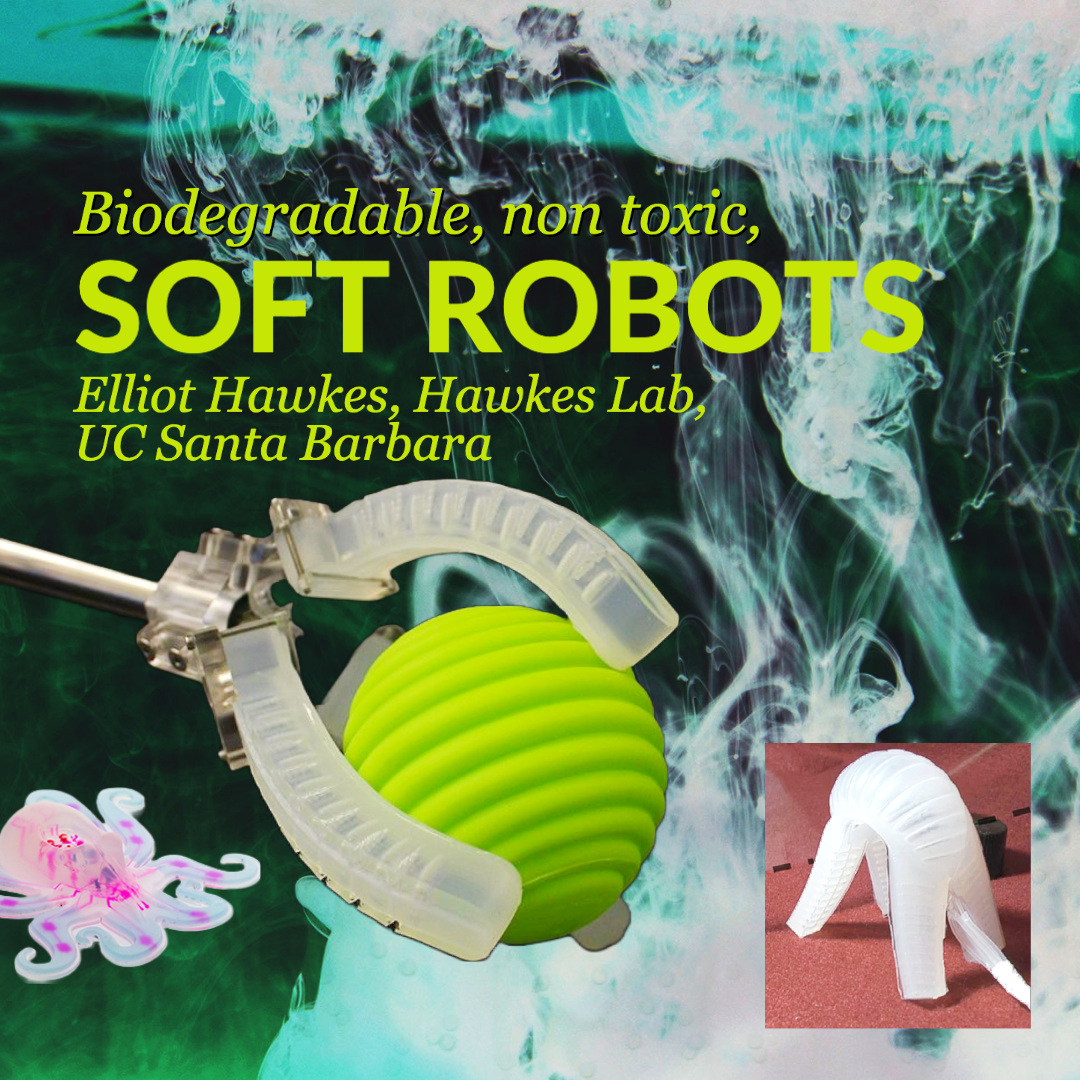
Octopus arms contain no bones—their flexibility emerges from muscular hydrostatic structures where muscle fibres arranged in three orthogonal directions contract around incompressible fluid. This architecture grants octopus arms virtually infinite degrees of freedom, allowing them to manipulate objects, navigate confined spaces, and execute complex motor tasks. Traditional robots rely on rigid joints and discrete degrees of freedom, limiting their adaptability and constraining their applications. Engineers at Harvard and UC Santa Barbara recognised that muscular hydrostat geometry could revolutionise robotics by enabling continuum manipulators without discrete joints. Soft robots built on octopus-inspired muscular hydrostat principles use silicone chambers and embedded actuators to mimic orthogonal muscle arrangements, achieving continuous deformation and force distribution throughout their structure. These robots navigate confined spaces, handle fragile objects, and adapt their shape to environments in ways rigid robots cannot, proving that biological principles of fluid-muscular integration fundamentally outperform mechanical engineering approaches in flexibility and resilience.

Biomimicry Breakdown

The Biomimicry Analysis

How Octopus (Octopodidae, Muscular Hydrostats) translates into Octopus Soft Robots

Term
Applied to Octopus Soft Robots
Function
Three muscle fibre layers—longitudinal, transverse, and helical—contract around incompressible fluid to create coordinated bending, twisting, and extension. Selective contraction of specific fibre groups produces complex shapes without rigid joint constraints.
Mechanism
Pressurised fluid transmitted through the muscular structure resists compression whilst muscle contraction redistributes fluid, creating shape changes. The incompressible fluid acts as a hydrostat skeleton, maintaining structural integrity whilst enabling continuous deformation.
Design Principle
Muscular hydrostats achieve superior flexibility and force control because fluid distribution allows stress dissipation across the entire structure rather than concentrating it at joint interfaces.
Resulting Design
Soft robots achieve manipulation precision equivalent to rigid robots whilst gaining adaptive flexibility, environmental robustness, and the ability to handle delicate objects with <0.5 kg grip force.

Find your own nature-inspired opportunities

Inspired by Octopus Soft Robots? The Biomimicry Opportunity Map scans your company website and suggests challenges worth solving the way nature would.

Get started →

Apply This

Design Application Prompts

There's a natural world to explore

Learn to find strategies like this yourself