The Problem
Wildfire early detection relies on expensive sensor networks requiring power, maintenance, and communication infrastructure. In remote or resource-limited fire zones, detection is delayed, reducing evacuation time and suppression effectiveness. Low-cost, maintenance-free early-warning systems are needed.
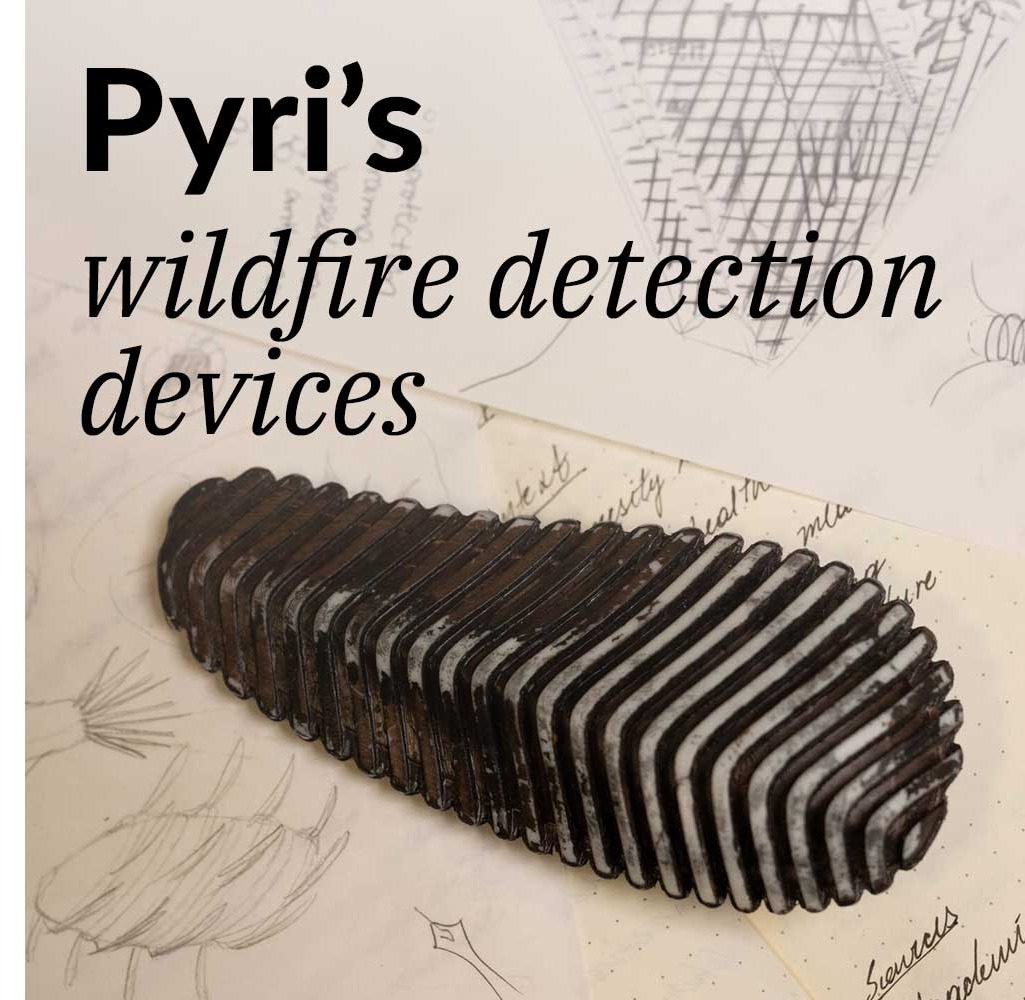
Pine cone's humidity-responsive opening/closing mechanism inspires early wildfire detection devices that require no electronics.
Pine cones are hygroscopic marvels: their scales contract when wet and expand when dry, dispersing seeds during optimal moisture conditions. This mechanical response requires no neural processing, sensors, or energy—it emerges purely from differential water absorption in the scale material's cell walls. When humidity drops below a critical threshold (typically 10-15%), scales open rapidly; when humidity rises, they close. Researchers at Pyri recognised that this threshold response—so finely calibrated in pines—could be engineered into a wildfire early-warning system. Pyri designed composite scales mimicking pine cone architecture: wood fibres arranged in specific grain directions, treated with water-responsive polymers. When relative humidity plummets (an early signature of encroaching wildfire), Pyri scales open, triggering a mechanical catch that activates a wireless alert. Critically, the device operates passively: no batteries, no circuitry to fail, no power draw. Field testing in fire-prone regions shows Pyri devices detect humidity drops 30-60 minutes before visible fire, enabling evacuation and early suppression. The system scales from individual property protection to forest-wide networks, costing mere pounds per unit, and requiring only passive maintenance.