Food and Agriculture
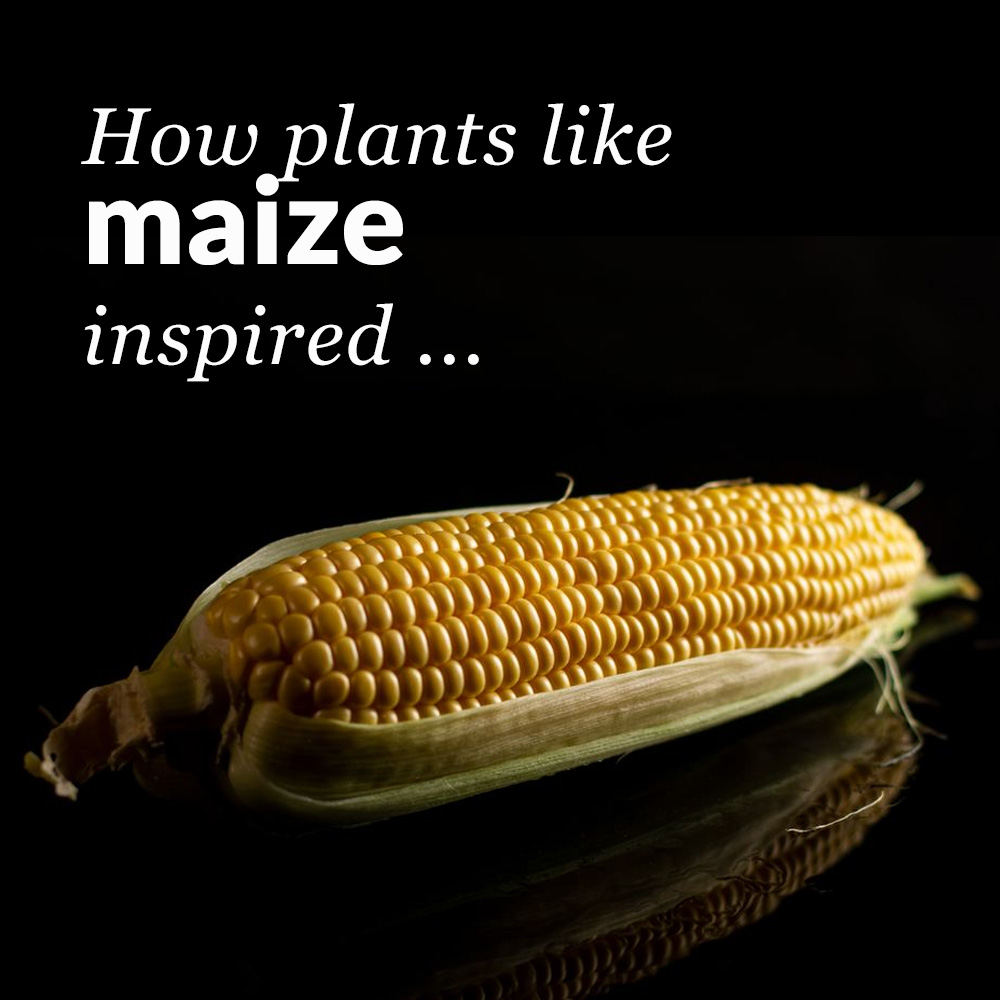
Maize / Sugarcane, the natural model for C4 Photosynthesis CO₂ Capture
C4 Photosynthesis CO₂ Capture: the human application

Inspired by: Maize / Sugarcane

C4 Photosynthesis CO₂ Capture

C Combinator / International Rice Research Institute

50%

Projected yield increase for C4-engineered rice over conventional C3 varieties

C4 carbon fixation efficiency under high temperature conditions

3.5B

People whose primary calorie source is rice

Population dependent on the crop that C4 engineering targets

25%

Carbon fixed by C3 plants lost to photorespiration

Wasteful side reaction that C4 architecture suppresses through CO₂ concentration

The Problem

Rice and other C3 crops lose up to 25 percent of photosynthetic output to photorespiration, reducing yields and increasing water and nitrogen demand — a vulnerability that worsens as climate change raises growing temperatures.

Engineering C4 carbon-fixation pathways into C3 crops and industrial reactors

Rice feeds more than 3.5 billion people and is the primary calorie source for the world's poorest populations. It is also a C3 crop — it uses the ancestral three-carbon photosynthetic pathway that loses up to 25 percent of fixed carbon to photorespiration, a wasteful side reaction of Rubisco that increases at higher temperatures. As climate change raises average growing temperatures, C3 crop yields are projected to fall precisely as demand rises.

C4 plants evolved a solution 60 million years ago. By pre-concentrating CO₂ into specialised bundle-sheath cells before delivering it to Rubisco, C4 plants suppress photorespiration almost entirely. The result is 50 percent higher water-use efficiency, 20 percent less nitrogen required per unit of biomass, and stable yields at temperatures where C3 crops decline. Maize, sugarcane, and sorghum are all C4 plants — all domesticated from tropical environments where the C4 advantage is most pronounced.

The C4 Rice Project at the International Rice Research Institute and the synthetic biology startup C Combinator are pursuing the transfer of C4 photosynthetic architecture into rice. The project involves introducing the anatomical bundle-sheath cell structure, the biochemical carbon-concentrating mechanism, and the regulatory gene networks that orchestrate C4 carbon fixation — a multi-gene, multi-tissue engineering challenge that represents one of the most ambitious crop improvement programmes in history.

Parallel work at C Combinator applies C4-inspired carbon concentrating mechanisms to industrial bioreactors, using engineered algae with enhanced Rubisco activity to capture atmospheric CO₂ at rates approaching the theoretical C4 optimum. If successful, C4-enhanced photosynthesis offers a pathway to food security under climate change while simultaneously providing the most energy-efficient known route to biological carbon capture.
Biomimicry Breakdown

The Biomimicry Analysis

How Maize / Sugarcane translates into C4 Photosynthesis CO₂ Capture

Term
Applied to C4 Photosynthesis CO₂ Capture
Function
C4 plants suppress photorespiration by pre-concentrating CO₂ into specialised bundle-sheath cells before delivering it to Rubisco, achieving 50 percent greater carbon fixation efficiency than C3 plants under high-temperature, high-light conditions.
Mechanism
The C4 two-cell system first fixes CO₂ into four-carbon acids in mesophyll cells, then releases and reconcentrates CO₂ in bundle-sheath cells around Rubisco — an ATP-powered pump that suppresses the oxygen side-reaction responsible for photorespiration losses.
Design Principle
Spatial CO₂ concentration replaces enzyme engineering: rather than modifying Rubisco itself, C4 architecture builds a delivery system that saturates the enzyme with CO₂ in a dedicated compartment, dramatically reducing wasteful oxygen competition.
Resulting Design
C4 rice trials show projected yield increases of 50 percent and water-use efficiency gains of 20 percent over conventional C3 rice — potentially stabilising food production for 3.5 billion people as climate change reduces C3 crop performance.

Find your own nature-inspired opportunities

Inspired by C4 Photosynthesis CO₂ Capture? The Biomimicry Opportunity Map scans your company website and suggests challenges worth solving the way nature would.

Get started →

Apply This

Design Application Prompts

There's a natural world to explore

Learn to find strategies like this yourself